Burntide Official Website › Blog › Added sugar vs glucose studies
Burntide Added Sugar vs Glucose Studies: What the Label and the Research Say
Two sugar questions get mixed up. One is how much sugar is in the gummy. The other is what vinegar and ketone studies found about blood glucose. This page keeps them apart and sets them side by side.
Each Burntide gummy has 8 calories, 2 g of total sugars and 1 g of added sugar, which is 2% of the Daily Value. Studies of vinegar and ketone supplements measured small shifts in blood glucose at much larger amounts than the gummy holds. Anyone on glucose-lowering medicine, or under a physician's care, should ask a professional first.
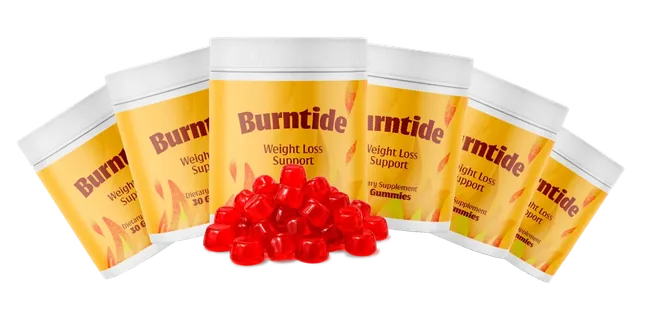
- Calories: 8 per gummy.
- Total carbohydrate: 2 g, 1% Daily Value.
- Sugars: 2 g total, with 1 g added sugar, which is 2% Daily Value.
- Sources of sugar: corn syrup and pure cane sugar are both named in the other ingredients.
- Studies: vinegar and ketone studies measured glucose shifts at amounts far above one gummy.
General information, not medical advice. Burntide is a dietary supplement for healthy adults aged 18 and over. It is not a drug, it is not FDA approved, and no supplement is. It is not intended to diagnose, treat, cure or prevent any disease. If you take medicine, are under a physician’s care, or are pregnant or nursing, ask a doctor or pharmacist before use.
What sugar does the Burntide label print?
The Supplement Facts panel prints the sugar lines in full. A serving is one gummy, 2.5 g. A jar holds 30.
| Line | Per gummy | % Daily Value |
|---|---|---|
| Calories | 8 | Not printed |
| Total carbohydrates | 2 g | 1% |
| Total sugars | 2 g | Dagger, not established |
| Includes added sugars | 1 g | 2% |
The dagger means a Daily Value is not established for that line. So no percentage can be printed for total sugars.
Where does the sugar in the gummy come from?
The other ingredients tell you. Corn syrup is first on the list. Pure cane sugar is third. Together they give bulk, texture and sweetness.
The site notes that roughly four fifths of the sweet is the sweet. The 525 mg blend is the active part of a 2.5 g gummy. The rest is the base. That is normal for a gummy, and it is printed on the bottle.
Anyone avoiding added sugar entirely should not buy it. That is one of the plain nos on the site.
What did vinegar and ketone studies find about glucose?
Both bodies of research touched glucose. A systematic review and meta-analysis of vinegar trials found small average changes in some glycaemic and lipid measures. A meta-analysis of exogenous ketone studies pooled the effect on blood glucose.
The two findings sit on the same page for a reason. They are why the label tells people under a physician's care to ask first.
| Source | What it measured | Amount used |
|---|---|---|
| Hadi 2021 | Glycaemic and lipid measures after vinegar | 15 to 30 mL of liquid vinegar a day |
| Falkenhain 2022 | Blood glucose after exogenous ketones | Grams |
| One Burntide gummy | No glucose study exists | 525 mg blend, split not published |
Does the added sugar cancel out the studies, or the other way round?
Neither can be said. The two numbers live in different worlds. The sugar line is a label fact for one gummy. The glucose findings are study results at far larger amounts of the active ingredients.
No study measured what one Burntide gummy does to blood glucose. This page will not guess at it. The point is that both facts are real, and both belong in the conversation with a clinician if blood sugar matters to you.
Who should ask a professional before using it?
The label makes asking a condition for anyone taking medication or under a physician's care. The site names the cases where the sugar and glucose questions matter most.
- Anyone taking insulin, sulfonylureas or other glucose-lowering drugs, because vinegar and ketones both moved glucose measures in trials.
- Anyone with a condition affecting blood sugar, the stomach, the kidneys or the heart.
- Anyone avoiding added sugar entirely.
- Anyone already taking a vinegar or ketone product, because that is stacking and the label does not print how much.
Bring the jar or a photo of the panel. A pharmacist can read a panel, and a brand name tells them nothing.
Is there a link between vinegar, glucose and stomach emptying?
The site draws one. Vinegar slowed stomach emptying in a small study of people with type 1 diabetes. A slower emptying rate changes the shape of what happens after a meal. That is the clearest reason the label places the gummy about 30 minutes before one.
It is also a reason for anyone with a diagnosed emptying disorder to ask first. At this size the effect is unlikely, but unlikely is not a promise. Ask rather than assume.
How should you read the sugar line on any gummy label?
- Find the added sugars line. It is the one that counts if you track added sugar.
- Note the serving size. Here it is one gummy, 2.5 g.
- Read the other ingredients for the sources: corn syrup, cane sugar, honey and so on.
- Multiply by the servings you plan to take. The label says one a day.
- Check whether a Daily Value is printed or replaced by a dagger.
For Burntide, that gives 1 g of added sugar a day at the printed dose, from corn syrup and cane sugar.
Frequently asked questions
How much sugar is in a Burntide gummy?
2 g of total sugars, of which 1 g is added sugar, which is 2% of the Daily Value. Each gummy has 8 calories.
Does Burntide contain corn syrup?
Yes. Corn syrup is first in the other ingredients, and pure cane sugar is also named.
Can Burntide change my blood sugar?
Studies of vinegar and ketone supplements measured small glucose shifts at much larger amounts. No study of the finished gummy exists, so ask a professional if blood sugar matters to you.
Is Burntide suitable if I avoid added sugar?
No. The site lists avoiding added sugar entirely as a reason not to buy it, since each gummy has 1 g of added sugar.
Should I ask a doctor if I use glucose-lowering medicine?
Yes. The label makes consulting a healthcare professional a condition of use for anyone taking medication or under a physician's care.
What does the dagger mean on the panel?
It means Daily Value not established, so no percentage can be printed. It appears against total sugars and against the proprietary blend.
Our view
The sugar line is the plainest fact on the label, and the glucose research is the most technical. Put them side by side and the message is simple: this is a sweet with a small active blend, and blood sugar questions belong with a clinician.
One gram of added sugar a day is small. It still matters to someone who counts it, so the panel prints it and the site says it.
If you use medicine that touches glucose, do not decide on a web page. Take the panel to a pharmacist, ask your question, and let the answer lead.
Sources named on this site
- Hadi A, Pourmasoumi M, Najafgholizadeh A, Clark CCT, Esmaillzadeh A. The effect of apple cider vinegar on lipid profiles and glycemic parameters: a systematic review and meta-analysis of randomized clinical trials. BMC Complement Med Ther. 2021;21(1):179. PMID 34187442. View source
- Falkenhain K, Daraei A, Forbes SC, Little JP. Effects of exogenous ketone supplementation on blood glucose: a systematic review and meta-analysis. Adv Nutr. 2022;13(5):1697-1714. PMID 35380602. View source
- Hlebowicz J, Darwiche G, Bjorgell O, Almer LO. Effect of apple cider vinegar on delayed gastric emptying in patients with type 1 diabetes mellitus: a pilot study. BMC Gastroenterol. 2007;7:46. PMID 18093343. View source
- Agbabiaka TB, Spencer NH, Khanom S, Goodman C. Prevalence of drug-herb and drug-supplement interactions in older adults: a cross-sectional survey. Br J Gen Pract. 2018;68(675):e711-e717. PMID 30249608. View source
- U.S. Food and Drug Administration. Dietary Supplement Labeling Guide. View source
- National Center for Complementary and Integrative Health. Using Dietary Supplements Wisely. View source
Last updated October 16, 2026.