Burntide Official Website › Guides › Safety Guide
A Safety Guide To Metabolism Supplements
Read the caution block first, take the panel rather than the brand name to a pharmacist, treat a proprietary blend as a ceiling rather than a dose, and report a reaction to FDA MedWatch so it counts. Supplements are behind an estimated 23,000 emergency visits a year in the United States, most of them avoidable with five minutes of the checks below.
Written to be used on any product in this aisle, including the one this website sells.
Read the caution block before the claims
Every supplement bottle has one and almost nobody reads it. It is usually two or three sentences long, it is written by the manufacturer’s own compliance people, and it is the most specific thing on the label about who should not use the product.
| The sentence | What it actually means |
|---|---|
| “Consult a healthcare professional before use if you are under a physician’s care or taking medication” | In that sentence the manufacturer is saying the decision is not yours alone. This is the commonest line and the most ignored |
| “Do not use if pregnant or nursing” | Usually absolute, occasionally hedged with “without consulting a physician”. Read which version you have |
| “Keep out of the reach of children” | Literal, and it matters far more on a chewable than on a capsule |
| “Do not use if the safety seal is damaged or missing” | The one hard rule on most labels. It is an instruction rather than advice |
| “Do not exceed the recommended dose” | Nothing above the printed serving has been studied, which is the whole reason the number is printed |
If a product's caution block is shorter than its claims list, that is worth noticing in itself.
The label on the product this website sells carries exactly that first sentence, and it is reproduced word for word on the safety page rather than paraphrased. Reproducing a caution block verbatim costs a seller nothing except the temptation to soften it.
Taking a panel to a pharmacist
This is the single highest-value thing in this guide and it is free. A pharmacist already holds your medication list, reads panels for a living, and will give you an answer in a few minutes at a counter.
Take the jar, or a photograph of the panel
Not the brand name. A brand name tells a pharmacist nothing; a Supplement Facts panel tells them the ingredients, the amounts where they are published and the other ingredients line, which is where allergens live.
Name what you already take, including other supplements
The under-reported half of this is supplement-on-supplement stacking. Two products containing the same ingredient are a dose question even when neither is a medicine.
Ask about three things specifically
Anything that affects blood glucose, anything with strict timing around food, and anything you are effectively duplicating. Those three cover most of what actually comes up.
A cross-sectional survey in general practice found a meaningful share of older adults taking supplement and medicine combinations with recognised interaction potential, and most had not mentioned the supplement to anybody (Agbabiaka and colleagues, 2018). The reason is rarely carelessness. A supplement does not feel like a drug, so it does not come up.
What the harm data actually shows
It is worth being accurate about this in both directions, because the category attracts both dismissal and alarm.
An analysis of United States emergency-department surveillance estimated roughly 23,000 supplement-related visits a year, with weight products and energy products prominent, and a skew toward older adults (Geller and colleagues, 2015). That is a real number and it is small against the number of people taking supplements. It is also not zero, and it is concentrated in exactly the categories this guide is about.
What that data supports
- That supplement harms happen and are not hypothetical.
- That weight and energy products are over-represented in the harm data.
- That older adults, who take more medicines, are over-represented too.
- That most events involve swallowing problems, allergic reactions or cardiac symptoms rather than anything exotic.
What it does not support
- That any particular product is dangerous. The data is about a category.
- That supplements are broadly unsafe. The absolute rate is low.
- That a product with a small amount of a studied ingredient carries the risks of a large amount.
- That avoiding supplements entirely is the only sensible response.
The practical conclusion is neither dismissal nor alarm: it is that the checks in this guide take five minutes and remove most of the avoidable part.
Why a proprietary blend changes what you can conclude
A proprietary blend declares a group of ingredients under one total without breaking out the amounts. The FDA labelling guide sets out the rule: every ingredient must be named and the total must be printed. It is legal, it is common, and it is usually there to protect a formula from being copied.
| You can conclude | You cannot conclude |
|---|---|
| The ceiling. Nothing in the blend exceeds the total | The amount of any individual ingredient |
| The identity of everything in it, because naming is required | Whether any of them is at a studied amount |
| That the total is smaller than it looks once split several ways | That the split is even, or that the first-named ingredient dominates |
| That nobody can compare it to research, including the seller | That the product does not work, which is a separate question with no answer |
A useful habit: take the blend total and compare it to the single largest trial dose among its ingredients. If the whole blend is smaller than one ingredient's studied dose, no arrangement of the split helps.
Run that on the product this website sells and the arithmetic is unflattering: a 525 mg blend against vinegar trials using tablespoons of liquid (Hadi 2021) and ketone salt studies using grams (Margolis 2020). Both comparisons are printed on the ingredients page, in a table, on the website that sells it.
How the format of a supplement changes its risks
The same ingredient in three formats carries three different risk profiles, and this is almost never discussed on product pages because it cuts across brands.
Tablets and capsules can lodge
A published case described oesophageal injury from a vinegar tablet that lodged on the way down, and the same investigation found label amounts that did not match contents (Hill 2005). Take them with a full glass of water, standing.
Chewables sit on the teeth
Anything acidic in a chewable has contact time. Vinegar varieties have measurable erosive potential on enamel in vitro (Willershausen 2014). Rinse with water, and leave brushing for half an hour.
Gummies carry sugar and are easy to over-take
A confection that tastes pleasant invites a second one. The printed serving is the only amount anybody has considered, and the added sugar is a real line on the panel rather than a rounding error for some people.
Powders carry a mineral load
Mineral salts at gram doses bring their minerals with them, which is why tolerability studies exist for them (Fischer 2018).
None of that makes any format wrong. It means the question “is this safe” has a different answer depending on what shape the product is in, and the shape is the part buyers notice least.
How to report a reaction so that it counts
Most mild reactions to anything are never reported. That is the single biggest gap in what is known about supplement safety, and it is the one part of this that an individual can actually change.
Stop, and speak to a clinician if it is more than mild
Take the jar. The panel, the other-ingredients line and the lot number are the three things a clinician will want and none of them is in your memory.
Report it to MedWatch
FDA MedWatch takes reports from members of the public. It is the mechanism that turns single reactions into a signal, and it takes a few minutes.
Tell the seller, with the lot number
A seller with a lot number on record can check whether anybody else has called about the same batch. A seller without one cannot do anything at all.
Two public sources worth bookmarking. The FDA’s dietary supplement pages explain what the framework does and does not require, and NCCIH’s guidance covers how to judge a supplement claim. Neither is selling anything, which is why they are the right places to start rather than any product website, this one included.
Supplement safety questions
How do I know if a supplement interacts with my medication?
Ask a pharmacist, with the jar or a photograph of the panel rather than the brand name. A pharmacist can read a panel; a brand name tells them nothing. Categories worth raising are anything affecting blood glucose, anything with strict timing around food, and any product duplicating something you already take.
Where do I report a reaction to a supplement?
In the United States, FDA MedWatch takes reports from members of the public as well as from clinicians. Reporting is how an individual reaction becomes a visible pattern, and most mild reactions are never reported to anybody.
Are supplements tested before they are sold?
Not in the way medicines are. The FDA does not approve dietary supplements before sale. Manufacturing is regulated, the label is regulated, and the product itself does not need a pre-market approval.
What is a proprietary blend and should I avoid one?
It is a group of ingredients declared under a single total, with the individual amounts withheld. It is legal and common. It is not a reason to avoid a product by itself, and it does mean you cannot compare any amount in it to research.
How this Burntide page was written
This desk publishes what the printed panel says and marks the gaps. The four claims below are the ones a sceptical reader can audit, which is the only reason to make them:
- The panel is the source. Figures come from the Supplement Facts panel on the bottle, not from the manufacturer’s sales page. Where the two disagree, the panel is published and the disagreement is named on the page.
- The gaps are marked, never filled in. Nothing undisclosed is estimated here, and that includes the split inside the 525 mg blend and the price.
- Sources are real and linked in the sentence. Every study cited was confirmed against its PubMed record first, and each appears beside the amount it used.
- Corrections change the date. Write to [email protected] and the review date moves forward.
We earn when you buy. Burntideformula is the official United States shop for this product and this website makes money on orders placed through it. That is exactly why the interaction list and the three-star reviews are on the site: they are where our interest and yours pull apart, and you should be able to watch us choose.
Every page, every journal post, the bottle facts and the ingredients go through review by Dr. Dean Tomlin before they ship. We write these pages from the printed Burntide Supplement Facts panel and this desk’s own paperwork, cite public research beside the amounts that research actually used, and print “not published” wherever a figure is not disclosed rather than estimating it. The roundel beside this note is a real seal from the sales page, and it names no clinician, which is why this website names none either. Corrections are made on the page itself and the review date moves forward. Write to [email protected]. Last reviewed September 2026 by Dr. Dean Tomlin.
Sources for this safety guide
- Hadi A, Pourmasoumi M, Najafgholizadeh A, Clark CCT, Esmaillzadeh A. The effect of apple cider vinegar on lipid profiles and glycemic parameters: a systematic review and meta-analysis of randomized clinical trials. BMC Complement Med Ther. 2021;21(1):179. PMID 34187442. View source
- Hill LL, Woodruff LH, Foote JC, Barreto-Alcoba M. Esophageal injury by apple cider vinegar tablets and subsequent evaluation of products. J Am Diet Assoc. 2005;105(7):1141-4. PMID 15983536. View source
- Willershausen I, Weyer V, Schulte D, Lampe F, Buhre S, Willershausen B. In vitro study on dental erosion caused by different vinegar varieties using an electron microprobe. Clin Lab. 2014;60(5):783-90. PMID 24839821. View source
- Fischer T, Och U, Klawon I, et al. Effect of a sodium and calcium DL-beta-hydroxybutyrate salt in healthy adults. J Nutr Metab. 2018;2018:9812806. PMID 29850235. View source
- Margolis LM, O'Fallon KS. Utility of ketone supplementation to enhance physical performance: a systematic review. Adv Nutr. 2020;11(2):412-419. PMID 31586177. View source
- Geller AI, Shehab N, Weidle NJ, et al. Emergency department visits for adverse events related to dietary supplements. N Engl J Med. 2015;373(16):1531-40. PMID 26465986. View source
- Agbabiaka TB, Spencer NH, Khanom S, Goodman C. Prevalence of drug-herb and drug-supplement interactions in older adults: a cross-sectional survey. Br J Gen Pract. 2018;68(675):e711-e717. PMID 30249608. View source
- U.S. Food and Drug Administration. Dietary Supplements. View source
- U.S. Food and Drug Administration. Dietary Supplement Labeling Guide. View source
- U.S. Food and Drug Administration. MedWatch: The FDA Safety Information and Adverse Event Reporting Program. View source
- National Institutes of Health, Office of Dietary Supplements. Dietary Supplements for Weight Loss: Fact Sheet for Health Professionals. View source
- National Center for Complementary and Integrative Health. Using Dietary Supplements Wisely. View source
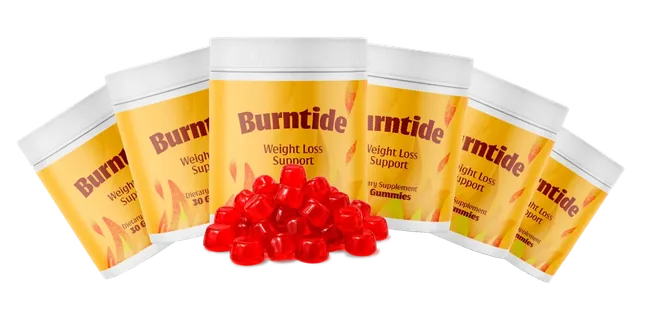
Order Burntide on the official website
If you have run the checks in this guide and the answer is still yes, the routine is one gummy a day before a meal.
Price shows at the checkout, before you pay
Order Burntide On The Official WebsiteOne-time payment, no subscription · 60-day money-back guarantee · lot BUR-26/BU-7063 · adults 18 and over