Burntide Official Website › Blog › Medication
Burntide And Your Medication: What To Check First
The Burntide label says to consult a healthcare professional before use if you are under a physician’s care or taking medication. This is what that conversation should cover, why the 525 mg blend makes it harder than it needs to be, and what the interaction data actually shows.
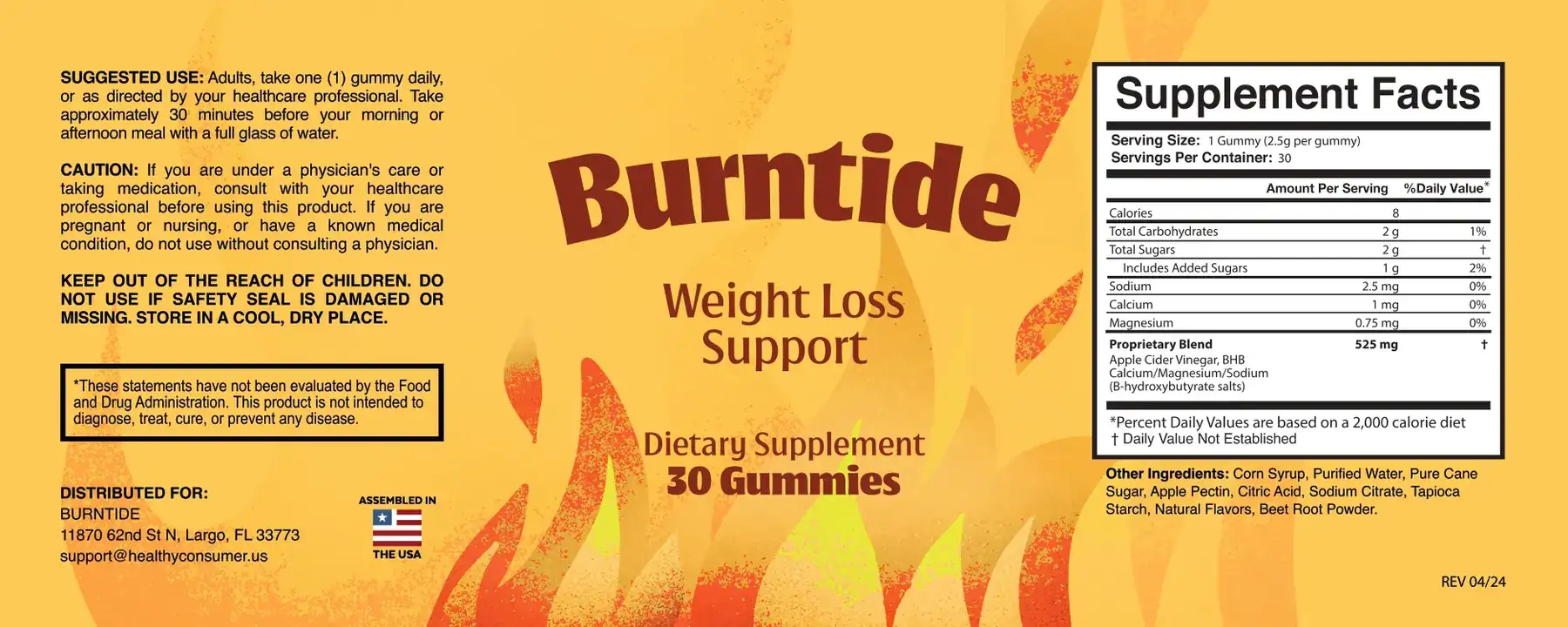
- The label makes asking a condition, not a suggestion: consult a healthcare professional before use if you are under a physician’s care or taking medication.
- The blend is 525 mg and is not broken down, so nobody can tell a pharmacist how much vinegar or how much BHB salt is involved.
- Three categories are worth naming: anything affecting blood glucose, anything with strict timing around food, and anything you already take that duplicates this.
- Take the panel, not the brand name. A pharmacist can read a panel. A brand name tells them nothing.
General information, not medical advice. Burntide is a dietary supplement for healthy adults aged 18 and over. It is not a drug, it is not FDA-approved, and it is not intended to diagnose, treat, cure or prevent any disease. If you are under a physician’s care, take any medicine, or are pregnant or nursing, speak to a clinician or a pharmacist before using any product on this shelf. Nothing on this page replaces that conversation.
Why this question comes up at all
Supplements do not feel like drugs. They are bought in a shop, they come without a prescription, and the one in front of you is a sweet. So they do not come up in conversations with clinicians, and the data on what happens next is not reassuring.
A cross-sectional survey in general practice found a meaningful proportion of older adults taking supplement and medicine combinations with recognised interaction potential, most of them without having mentioned the supplement to anybody (Agbabiaka and colleagues, 2018). The blunter number comes from United States emergency-department surveillance: roughly 23,000 supplement-related visits a year, with weight and energy products over-represented and a skew toward older adults (Geller and colleagues, 2015).
Neither of those is a statement about Burntide specifically. They are the reason the question deserves ten minutes rather than a shrug, on any product in this aisle.
What the label actually says
Here is the caution block from the Burntide bottle, word for word:
“If you are under a physician's care or taking medication, consult with your healthcare professional before using this product. If you are pregnant or nursing, or have a known medical condition, do not use without consulting a physician.”
The printed Burntide label, revision REV 04/24
Two things are worth noticing. The first sentence is conditional on you, not on the product: if a clinician is already treating you, or a pharmacist already fills a prescription for you, the manufacturer is saying the decision is not yours alone. The second sentence handles pregnancy and nursing without the hedging that usually comes with it.
That is more specific than many labels in this category manage, and it is reproduced in full on the safety page rather than paraphrased. A caution block is the one paragraph on a supplement bottle written by people whose job is to be accurate rather than persuasive.
The three categories worth naming
You do not need to memorise an interaction list. Three categories cover most of what actually comes up with these two ingredients, and each one is a question rather than a verdict.
| Category | Why it comes up here | The question |
|---|---|---|
| Anything affecting blood glucose | Vinegar and exogenous ketones both move glucose measures in trials | Whether adding something that touches post-meal glucose is sensible while a dose is being adjusted |
| Anything with strict food timing | The label puts the gummy 30 minutes before a meal, which is a fixed point in the day | Whether that collides with a medicine that must be taken on an empty stomach or at a set distance from food |
| Anything you already take that duplicates it | Two sources of the same compound is a dose question even when neither is a medicine | Whether you are stacking, and by how much |
A fourth worth raising if it applies to you: a diagnosed gastroparesis or emptying disorder, for the reason in the timing section below.
Anything that touches blood glucose
This is the one most people already suspect and the one worth being precise about.
The vinegar literature is about meals. A systematic review and meta-analysis of randomised trials reported small average changes in some glycaemic and lipid measures (Hadi 2021), and a more recent review of body composition in people with type 2 diabetes or overweight landed in similarly modest territory (Castagna 2025). The ketone side has its own meta-analysis of what exogenous ketones do to blood glucose (Falkenhain 2022).
All of those studies used far more of the relevant ingredient than a 525 mg blend can contain, and most pharmacists will say so. The point of asking is not that the answer is likely to be alarming. It is that the person best placed to say “that is too small to matter for you” is somebody who knows what else you take, and that is not a website.
Read the safety page before the pricing page
That is an odd thing for a seller to write and it is the order these pages were built in. One gummy a day for healthy adults eighteen and over, with the whole caution block reproduced.
Price shows at the checkout, before you pay
Order BurntideAnything with strict timing around food
This is the category people miss, because it is not an interaction in the chemical sense. It is a scheduling collision.
The Burntide label puts the gummy approximately thirty minutes before a morning or afternoon meal. If you already take something that must be swallowed on an empty stomach, or a fixed distance from food, you now have two fixed points in the same part of the day and they may not both fit.
There is also a mechanical reason this category exists. Vinegar slowed gastric emptying in a small study of people with type 1 diabetes (Hlebowicz and colleagues, 2007), which is part of why the timing instruction is on the label at all. For most people that is a curiosity. For anyone with a diagnosed emptying disorder it is a reason to ask whether a vinegar product belongs in the routine at all.
- ›Write down what time you take each medicine before you go to the counter
- ›Say which meal you were planning to attach the gummy to
- ›Ask whether moving the gummy to the other meal solves it, because it often does
- ›If you have gastroparesis or a diagnosed emptying problem, raise that specifically
Anything you already take
The under-discussed half of this is supplement-on-supplement stacking. Two products containing the same ingredient are a dose question even when neither of them is a medicine, and nobody tracks it because neither product feels like a drug.
For this panel the two to watch are obvious: another apple cider vinegar product, and any exogenous ketone powder or capsule. Ketone salt products are sold at gram doses (Margolis 2020), so stacking one of those with this gummy is arithmetically dominated by the powder, but the pharmacist should still hear about both.
| What you already take | What changes |
|---|---|
| A liquid or tablet apple cider vinegar product | You are taking vinegar twice. The liquid is almost certainly the larger source, and the acid exposure to teeth is the part worth mentioning |
| A BHB ketone powder or capsule | The powder dominates the arithmetic completely. This gummy adds a fraction of 525 mg to something measured in grams |
Neither is dangerous by itself. Both are worth saying out loud, because a pharmacist cannot advise on a product you did not mention.
The complication nobody can solve for you
Every conversation above would be easier if the label broke the 525 mg blend into its parts. It does not. Apple cider vinegar and BHB calcium, magnesium and sodium share one total, and the split is not published.
So a pharmacist cannot be told how much vinegar or how much BHB salt is involved, and neither can this website. What can be said is the ceiling: nothing in that blend exceeds 525 mg, because that is the whole of it, and every trial cited on this page used more of either ingredient than the entire blend weighs.
That is a genuine limitation of this product and it is set out at length on the label page. It is legal, it is common, and it is the one figure that would make this conversation simple.
How to have the conversation
Take the jar, or a photograph of the panel
Not the brand name. A Supplement Facts panel tells a pharmacist the ingredients, the amounts where they are published, and the other-ingredients line, which is where allergens live. A brand name tells them nothing at all.
Name everything, including the other supplements
Prescriptions, over-the-counter medicines and every supplement. The last group is the one that gets left out and the one this page is about.
Ask the three questions
Anything glucose-related, anything with fixed food timing, anything you are duplicating. Those three cover most of what comes up with this panel.
It takes about five minutes at a counter and it costs nothing. It is the single highest-value thing in this article, and it applies to every product on the shelf beside this one.
What to do if something goes wrong
Stop taking it. If it is more than mild, speak to a clinician and take the jar with you, because the panel, the other-ingredients line and the lot number are the three things they will want and none of them is in your memory.
Then report it to FDA MedWatch, which takes reports from members of the public rather than only from clinicians. Most mild reactions to anything are never reported to anybody, which is the largest single gap in what is known about supplement safety. Finally, call +1 (631) 016-1313 with the lot number so it is recorded here too, and ask about the guarantee on the same call.
The honest summary
For a healthy adult on no medication, this is a short conversation and the answer is usually that nothing on this panel is large enough to interact with anything. For anyone on a prescription, the label makes asking a condition rather than a suggestion, and the unpublished blend means nobody can shortcut the conversation with arithmetic.
Five minutes at a pharmacy counter settles it either way. If you would rather read the detail first, the safety page carries the full interaction table and the suitability page carries the six situations where the answer is a plain no.
Sources cited in this article
- Hadi A, Pourmasoumi M, Najafgholizadeh A, Clark CCT, Esmaillzadeh A. The effect of apple cider vinegar on lipid profiles and glycemic parameters: a systematic review and meta-analysis of randomized clinical trials. BMC Complement Med Ther. 2021;21(1):179. PMID 34187442. View source
- Castagna A, et al. Effect of apple cider vinegar intake on body composition in humans with type 2 diabetes and/or overweight: a systematic review and meta-analysis of randomized controlled trials. Nutrients. 2025;17(18). PMID 41010525. View source
- Hlebowicz J, Darwiche G, Bjorgell O, Almer LO. Effect of apple cider vinegar on delayed gastric emptying in patients with type 1 diabetes mellitus: a pilot study. BMC Gastroenterol. 2007;7:46. PMID 18093343. View source
- Falkenhain K, Daraei A, Forbes SC, Little JP. Effects of exogenous ketone supplementation on blood glucose: a systematic review and meta-analysis. Adv Nutr. 2022;13(5):1697-1714. PMID 35380602. View source
- Margolis LM, O'Fallon KS. Utility of ketone supplementation to enhance physical performance: a systematic review. Adv Nutr. 2020;11(2):412-419. PMID 31586177. View source
- Geller AI, Shehab N, Weidle NJ, et al. Emergency department visits for adverse events related to dietary supplements. N Engl J Med. 2015;373(16):1531-40. PMID 26465986. View source
- Agbabiaka TB, Spencer NH, Khanom S, Goodman C. Prevalence of drug-herb and drug-supplement interactions in older adults: a cross-sectional survey. Br J Gen Pract. 2018;68(675):e711-e717. PMID 30249608. View source
- U.S. Food and Drug Administration. MedWatch: The FDA Safety Information and Adverse Event Reporting Program. View source

Every page, every journal post, the bottle facts and the ingredients go through review by Dr. Dean Tomlin before they ship. We write from the printed Burntide Supplement Facts panel and this desk’s own paperwork, cite public research beside the amount that research actually used, and print “not published” wherever a figure is not disclosed rather than estimating it. This website earns when you buy. Corrections are made on the page itself and the review date moves forward. Write to [email protected]. Last updated September 17, 2026.