Burntide Official Website › Blog › BHB salt forms vs mineral lines
Calcium BHB, Magnesium BHB and Sodium BHB: Salt Forms Compared With the Burntide Mineral Lines
Searches for calcium BHB benefits and sodium BHB benefits are really label questions. Why do three minerals show up on a gummy panel at near-zero amounts? This page compares the salt forms with the mineral lines and says what is not published.
BHB salts bind a ketone body to a mineral: calcium, magnesium or sodium. That is why those three minerals appear on the Burntide panel, at 1 mg, 0.75 mg and 2.5 mg per gummy, all 0% Daily Value. The BHB amount inside the 525 mg blend is not published, so no benefit can be stated for this gummy.
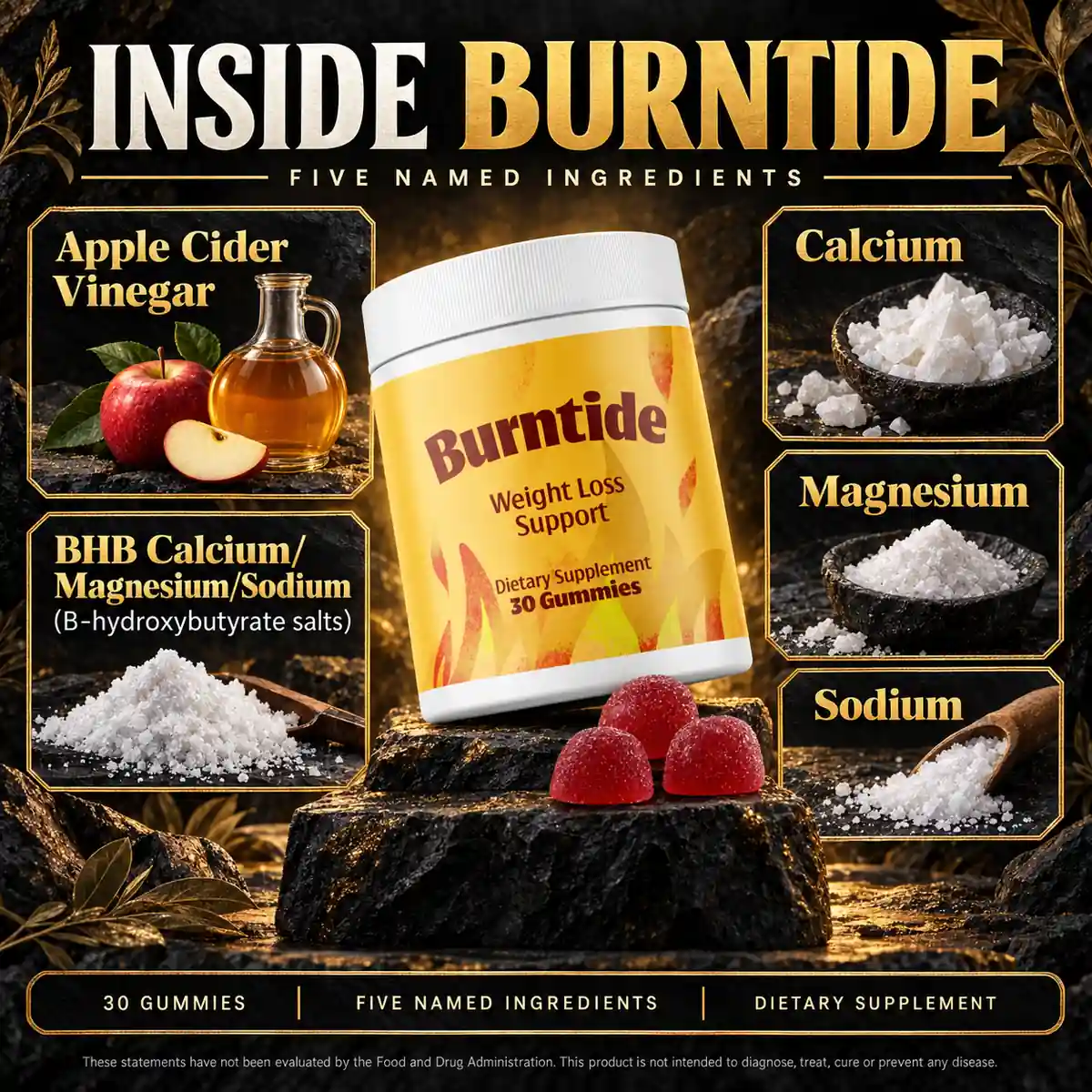
- Calcium: 1 mg per gummy, 0% Daily Value.
- Magnesium: 0.75 mg per gummy, 0% Daily Value.
- Sodium: 2.5 mg per gummy, 0% Daily Value.
- BHB salts: inside a 525 mg proprietary blend with apple cider vinegar. The split is not published.
- Benefits: no benefit of calcium BHB, magnesium BHB or sodium BHB is published for this gummy.
General information, not medical advice. Burntide is a dietary supplement for healthy adults aged 18 and over. It is not a drug, it is not FDA approved, and no supplement is. It is not intended to diagnose, treat, cure or prevent any disease. If you take medicine, are under a physician’s care, or are pregnant or nursing, ask a doctor or pharmacist before use.
What is a BHB salt, and why does it carry a mineral?
Beta-hydroxybutyrate, or BHB, is a ketone body. Your liver makes it when carbohydrate runs short, for example during fasting or on a ketogenic diet. Some tissues, including the brain, can use it as fuel.
Sold as a supplement, BHB is bound to a mineral. The bound form is called a salt. It is usually calcium, magnesium or sodium. The mineral makes the compound stable. It is also why the same three minerals appear on this panel.
So calcium BHB, magnesium BHB and sodium BHB are not three different products. They are three ways of carrying one ketone body.
What do the mineral lines on the Burntide panel say?
The panel declares each mineral on its own line. The amounts are tiny, and the panel prints 0% Daily Value for all three.
| Mineral | Per gummy | Adult reference | Plain reading |
|---|---|---|---|
| Calcium | 1 mg, 0% DV | 1,000 to 1,200 mg a day (NIH ODS) | About a thousandth of a day's need |
| Magnesium | 0.75 mg, 0% DV | 310 to 420 mg a day (NIH ODS) | Far too small to matter either way |
| Sodium | 2.5 mg, 0% DV | Under 2,300 mg a day is the ceiling (FDA) | About a thousandth of the ceiling |
Nobody is supplementing a mineral with this gummy. The three lines are a by-product of the salt form.
What are the calcium BHB and sodium BHB benefits for this gummy?
None are published. That is the honest answer. The label makes five support statements about normal body processes. It names no benefit tied to any single mineral or to either salt.
The wider research is also thin for this size. Studies of BHB salts raised blood ketones at gram doses. They measured blood levels, glucose and safety markers. They did not test a milligram-scale amount inside a gummy.
So a page that lists benefits of calcium BHB or sodium BHB for Burntide would be inventing them. This one will not.
How much BHB salt is in one gummy?
Not published. The panel prints one proprietary blend of 525 mg. Apple cider vinegar and the BHB calcium, magnesium and sodium salts share it. The label does not say how it splits.
What can be said is the ceiling. Nothing in the blend can weigh more than 525 mg, because that is the whole blend. That is roughly half a gram, and it is shared with the vinegar.
- Known: the total of the blend, 525 mg.
- Known: the three minerals named under it.
- Not published: the BHB amount, the vinegar amount, and the ratio between them.
- Not published: how much of each mineral comes from the BHB salts and how much from elsewhere.
What amounts did the BHB salt studies use?
Grams. The site's sources include a review of ketone supplements for physical performance, a measurement of blood BHB across several newer formulations, a meta-analysis of blood glucose, a tolerability study of a sodium and calcium BHB salt in healthy adults, and a safety-marker trial in adolescents.
| Source | What it looked at | Size of dose |
|---|---|---|
| Margolis 2020 | Ketone supplements and physical performance | Grams |
| Falkenhain 2022 | Exogenous ketones and blood glucose | Grams |
| Falkenhain 2024 | Blood BHB and glucose with newer formulations | Grams |
| Fischer 2018 | A sodium and calcium BHB salt in healthy adults | Grams |
| Stefan 2021 | BHB salt safety markers in adolescents | Grams |
The comparison is stark. One gummy holds a blend of 525 mg for both actives. No reading of the panel puts a studied BHB dose in one gummy.
Do the minerals in BHB salts matter for safety?
At study doses they can. A meta-analysis linked calcium supplements, at real supplement amounts, to a modest rise in cardiovascular events. Another paper argued that the upper limit for supplemental magnesium needs a fresh look.
Neither point applies at 1 mg or 0.75 mg. They are useful only to show the scale of what does apply, and how far below it this panel sits.
The sodium line is also small. A person on a sodium-restricted diet can see that 2.5 mg is a tiny part of the ceiling. They should still mention the gummy to their clinician, because the point of telling them is the whole picture.
How do you read any BHB label for the salt form?
Use these five questions on any product, not only this one.
- Which mineral is the BHB bound to? Calcium, magnesium, sodium, or a mix?
- What is the BHB amount per serving, in grams or milligrams?
- Is the amount printed, or hidden in a blend total?
- Does the directions line say how many servings a day?
- Does the panel also add the same mineral separately, which would change the total load?
For Burntide the answers are: calcium, magnesium and sodium; not published; hidden in a blend; one gummy daily; and no, the three mineral lines are declared once.
Who should ask a professional before taking a BHB gummy?
The label makes asking a condition for anyone under a physician's care or taking medication. The site adds anyone with a condition affecting blood sugar, the stomach, the kidneys or the heart, and anyone already taking a vinegar or ketone product.
Stacking is the key word. A second source of the same compound is a dose question. Since the blend is not split, nobody can tell a pharmacist how much BHB is involved.
Frequently asked questions
What are BHB calcium, magnesium and sodium?
They are salt forms of beta-hydroxybutyrate, a ketone body, bound to a mineral. On the Burntide panel they sit inside a 525 mg blend with apple cider vinegar.
Why does Burntide list calcium, magnesium and sodium separately?
Because the BHB salt form carries those minerals. They are declared at 1 mg, 0.75 mg and 2.5 mg per gummy, each at 0% Daily Value.
What are the benefits of calcium BHB or sodium BHB in Burntide?
No benefit is published for this gummy. The amount of BHB inside the 525 mg blend is not published, and no clinical trial of the finished gummy exists.
Is Burntide a calcium or magnesium supplement?
No. At 1 mg of calcium and 0.75 mg of magnesium per gummy, it is not a mineral supplement. The minerals come with the salt form.
Can Burntide put me in ketosis?
No. Nutritional ketosis is produced by diet or fasting, and studies that raised blood ketones used grams. A 525 mg blend shared with vinegar cannot do it.
Is the sodium in Burntide a concern?
At 2.5 mg per gummy it is a tiny share of the daily ceiling. Anyone on a sodium-restricted diet should still tell their clinician about it.
Our view
The three minerals look important on a panel and are not. They are there because the salt form puts them there. At 1 mg, 0.75 mg and 2.5 mg they round to zero percent of a day's need.
The real question is the one the label will not answer: how much BHB is in the blend. Until a split is published, any benefit claim for calcium BHB, magnesium BHB or sodium BHB in this gummy is a guess.
If you want a dose you can check, this label cannot give it. If you want a small daily habit and can accept that, the minerals are no reason to worry. Ask a pharmacist first if you take medicine.
Sources named on this site
- Margolis LM, O'Fallon KS. Utility of ketone supplementation to enhance physical performance: a systematic review. Adv Nutr. 2020;11(2):412-419. PMID 31586177. View source
- Falkenhain K, Daraei A, Forbes SC, Little JP. Effects of exogenous ketone supplementation on blood glucose: a systematic review and meta-analysis. Adv Nutr. 2022;13(5):1697-1714. PMID 35380602. View source
- Falkenhain K, Islam H, Little JP. The effect of novel exogenous ketone supplements on blood beta-hydroxybutyrate and glucose. J Diet Suppl. 2024;21(1):38-52. PMID 36847287. View source
- Fischer T, Och U, Klawon I, et al. Effect of a sodium and calcium DL-beta-hydroxybutyrate salt in healthy adults. J Nutr Metab. 2018;2018:9812806. PMID 29850235. View source
- Stefan M, Sharp M, Gheith R, et al. The effect of exogenous beta-hydroxybutyrate salt supplementation on metrics of safety and health in adolescents. Nutrients. 2021;13(3). PMID 33807731. View source
- Bolland MJ, Avenell A, Baron JA, et al. Effect of calcium supplements on risk of myocardial infarction and cardiovascular events: meta-analysis. BMJ. 2010;341:c3691. PMID 20671013. View source
- Costello R, Rosanoff A, Nielsen F, West C. Perspective: call for re-evaluation of the tolerable upper intake level for magnesium supplementation in adults. Adv Nutr. 2023;14(5):973-982. PMID 37487817. View source
- National Institutes of Health, Office of Dietary Supplements. Calcium: Fact Sheet for Health Professionals. View source
- National Institutes of Health, Office of Dietary Supplements. Magnesium: Fact Sheet for Health Professionals. View source
- U.S. Food and Drug Administration. Sodium in Your Diet: Use the Nutrition Facts Label and Reduce Your Intake. View source
Last updated October 16, 2026.