Burntide Official Website › Blog › Burntide supplement
What Kind of Burntide Supplement Is It? Supplement, Drug and Food Compared
The Burntide supplement is a chewable gummy sold as a dietary supplement, and that single phrase changes what the label can say and what has been checked before sale. This page compares a supplement with a drug and with a food, using Burntide’s own label as the example.
The Burntide supplement is a chewable gummy sold as a dietary supplement for healthy adults aged 18 and over. It is not a drug and not a food. The FDA does not approve supplements before sale, so Burntide is not FDA approved. Its label has a Supplement Facts panel, five support statements and a printed FDA disclaimer.
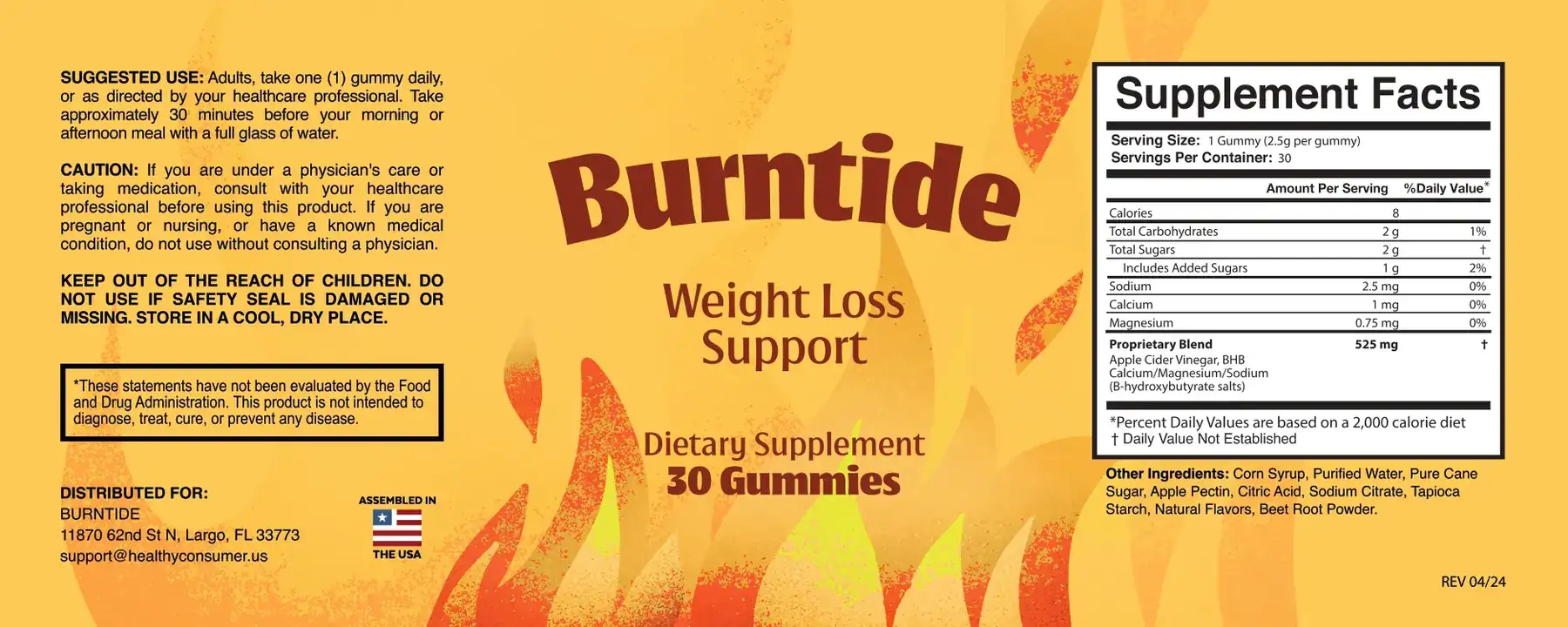
- Product type: a chewable gummy sold as a dietary supplement. Not a capsule, tablet or liquid.
- Serving: 1 gummy of 2.5 g, with 30 servings per container.
- Panel: Supplement Facts. It shows 8 calories, 2 g of sugars and a 525 mg proprietary blend.
- Claims: five support statements, with the FDA disclaimer beneath them.
- FDA status: not approved. No supplement is, because none is approved before sale.
- Intended for: adults aged 18 and over who are in good health.
This page is general information, not medical advice. A supplement is not a drug, cannot treat or cure a disease, and is no replacement for medicine your doctor has prescribed. If you take medicine, are under a physician’s care, or are pregnant or nursing, ask a doctor or pharmacist before using Burntide.
What kind of Burntide supplement is it?
The front of the jar says Dietary Supplement and 30 Gummies. The panel on the side is headed Supplement Facts. Those two phrases are the product’s legal clothing: it is sold as a dietary supplement, in chewable gummy form, with one gummy a day.
It is not a capsule, a tablet or liquid drops, unlike some lookalike products. It is also not a drug, and not a food replacement. It is a small daily gummy of 2.5 g, with a labelled blend of apple cider vinegar and BHB salts.
Burntide supplement vs drug vs food: what is the difference?
| Question | Dietary supplement (Burntide) | Drug | Food |
|---|---|---|---|
| Panel on the pack | Supplement Facts | Drug Facts or a prescription label | Nutrition Facts |
| Approved by FDA before sale | No | Typically yes, after review | No, but food rules apply |
| May claim to treat a disease | No | Yes, if approved for it | No |
| May make support statements | Yes, with the FDA disclaimer | Not the same kind of statement | Limited |
| Who should ask a professional first | Anyone on medicine, under a physician’s care, pregnant or nursing | Everyone, via a prescriber or pharmacist | Rarely |
The second row is the one people misread. Not approved before sale does not mean banned or unsafe. It means the approval step does not exist for this category.
What does the Supplement Facts panel show?
One gummy (2.5 g) is the serving, and there are 30 servings in the container. Per serving the panel lists 8 calories, 2 g of total carbohydrates, 2 g of total sugars with 1 g added, sodium 2.5 mg, calcium 1 mg, magnesium 0.75 mg and a proprietary blend of 525 mg.
A dagger beside the sugars and the blend means a Daily Value is not established. The blend names apple cider vinegar and BHB calcium, magnesium and sodium, and it does not say how the 525 mg is shared between them. The supplement facts page reproduces the panel row by row.
What can this kind of supplement claim, and what can it not?
Five support lines are printed on the bottle: Weight Loss Support, Support a healthy metabolism, Support the body’s natural fat-burning pathways, Support clean cellular energy and Support healthy fat oxidation. They are structure and function statements, a category that describes normal body processes. Beneath them is the FDA disclaimer: these statements have not been evaluated by the Food and Drug Administration, and the product is not intended to diagnose, treat, cure or prevent any disease.
So the label may say what the product is meant to support. It may not say it treats a condition. This website follows the same rule. It does not use disease words about Burntide, and it does not carry a weight or fat-burning promise on its marketing pages.
Why is it not FDA approved?
Because the FDA does not approve dietary supplements before they go on sale. A manufacturer does not need permission to sell one, and no product in the category has an approval to show. That is why a page that says a supplement is FDA approved is wrong, and why this website never writes it.
The marks on the jar are real but are not approval. FDA-registered facility is a filing. GMP certified is a standard for the facility’s procedures. The post comparing those seals explains each in turn.
What does a proprietary blend mean on a supplement?
It means the maker lists the ingredients together with one total weight, and does not state each ingredient’s share. On Burntide the total is 525 mg per gummy. Apple cider vinegar and the BHB salts sit inside it, and nobody outside the maker can say how much of either.
That matters because the research on both ingredients used far more. Vinegar trials used 15 to 30 mL of liquid vinegar a day, and BHB salt studies used doses measured in grams. So the label does not let a reader compare the gummy with a studied dose.
What else is in the gummy besides the blend?
The other-ingredients line reads: Corn Syrup, Purified Water, Pure Cane Sugar, Apple Pectin, Citric Acid, Sodium Citrate, Tapioca Starch, Natural Flavors, Beet Root Powder. They make the gummy chewable and sweet. They are also why it holds 2 g of sugars, and why it is not for anyone who must avoid added sugar entirely.
Who is it for, and who should ask first?
The product is intended for healthy adults aged 18 and over. The label asks anyone under a physician’s care or taking medication to consult a healthcare professional before use, and says that anyone pregnant or nursing, or with a known medical condition, should not use it without consulting a physician.
The post on who should not take Burntide lists the groups. A supplement is not a substitute for medicine your doctor has prescribed.
How do you read any supplement label?
- Find the words Dietary Supplement and the Supplement Facts panel.
- Check the serving size and servings per container.
- Look for amounts per ingredient, and for a blend with only a total.
- Read the other ingredients, especially sugars and allergens.
- Read the caution text and the disclaimer.
- Note the lot code and the label revision.
The FDA’s dietary supplement labeling guide and the NIH Office of Dietary Supplements both explain the layout in plain terms.
Frequently asked questions
Is Burntide a drug?
No. It is sold as a dietary supplement and is not intended to diagnose, treat, cure or prevent any disease.
Is the Burntide supplement FDA approved?
No. The FDA does not approve dietary supplements before sale, so no supplement is FDA approved.
What form is the Burntide supplement?
A chewable gummy of 2.5 g, one a day, with 30 in a jar. It is not a capsule, tablet or liquid.
What does the Supplement Facts panel not tell me?
It does not say how the 525 mg blend is split between apple cider vinegar and the BHB salts.
Can a supplement replace my medicine?
No. Do not stop or swap a prescribed medicine for a supplement without speaking to your doctor.
Who should check with a doctor first?
Anyone under a physician’s care, taking medication, pregnant or nursing, or with a known medical condition.
Our view
The Burntide supplement is what its label says it is: a chewable dietary supplement, with a blend whose split is not published and a set of support statements that carry a disclaimer. It is not a drug, and it has no FDA approval to display, which is true of every supplement.
That is not a reason to avoid it. It is a reason to read it the way you would read any supplement: panel, serving, blend, other ingredients, caution text.
If you take medicine or have a condition, the conversation with a pharmacist comes before the order, not after. If you are a healthy adult, use the guarantee window and give the reported timeline an honest try.
Sources named on this site
- U.S. Food and Drug Administration. Dietary Supplements. View source
- U.S. Food and Drug Administration. Questions and Answers on Dietary Supplements. View source
- U.S. Food and Drug Administration. Structure/Function Claims. View source
- U.S. Food and Drug Administration. Dietary Supplement Labeling Guide. View source
- National Center for Complementary and Integrative Health. Using Dietary Supplements Wisely. View source
- National Institutes of Health, Office of Dietary Supplements. Dietary Supplements for Weight Loss: Fact Sheet for Health Professionals. View source
Last updated October 23, 2026.