Burntide Official Website › Blog › Other Ingredients
Corn Syrup In A Metabolism Gummy: Reading The Other Ingredients
About four fifths of a Burntide gummy is not the active blend. Nine other ingredients are named on the panel, corn syrup is the first of them, and that line is where allergens live on any supplement label.
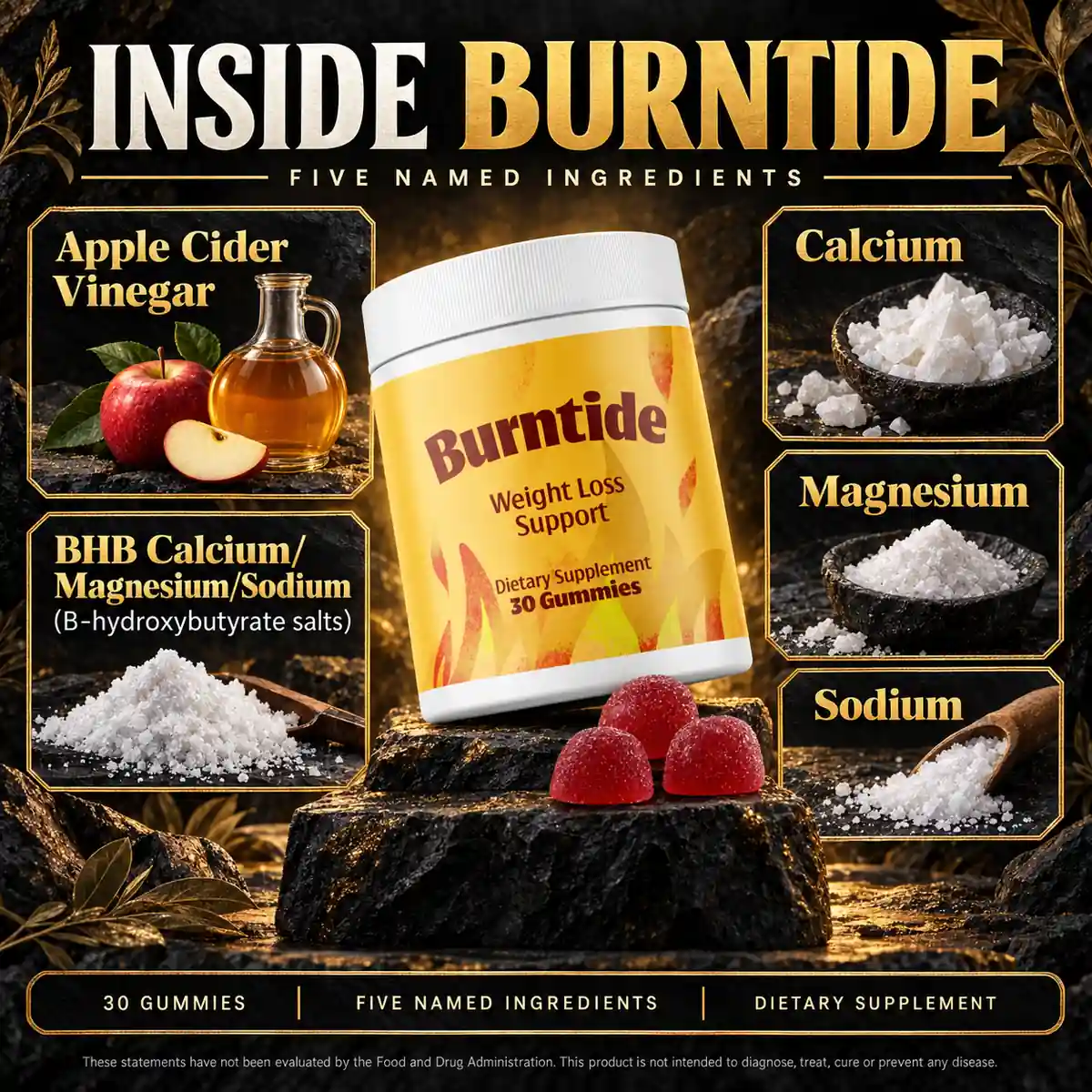
- The blend is 525 mg of a 2.5 g sweet. Roughly four fifths of the gummy is the gummy.
- Nine other ingredients are named, and corn syrup is the first of them.
- 2 g of sugars, 1 g added, at 2 percent of the Daily Value.
- Apple pectin rather than gelatin is what makes a vegetarian claim possible on any gummy.
General information, not medical advice. Burntide is a dietary supplement for healthy adults aged 18 and over. It is not a drug, it is not FDA-approved, and it is not intended to diagnose, treat, cure or prevent any disease. If you are under a physician’s care, take any medicine, or are pregnant or nursing, speak to a clinician or a pharmacist before using any product on this shelf. Nothing on this page replaces that conversation.
What the other-ingredients line is
Every supplement label has two ingredient lists. The Supplement Facts panel carries the actives and their amounts. Underneath it, usually in smaller type, an “other ingredients” line names everything else: binders, fillers, setting agents, colours, flavours and preservatives.
The FDA labelling guide requires that second list in descending order of predominance, which is why the first item on it is the most informative. On the Burntide panel that first item is corn syrup.
This line is the most-skipped part of a supplement label and the part most likely to contain the thing somebody reacts to. It is worth two minutes on any product you are considering, including this one.
The nine, one at a time
Here is the full line as printed: Corn Syrup, Purified Water, Pure Cane Sugar, Apple Pectin, Citric Acid, Sodium Citrate, Tapioca Starch, Natural Flavors, Beet Root Powder. And here is what each one is doing.
| Ingredient | What it is doing | Worth knowing |
|---|---|---|
| Corn syrup | Bulk, texture and sweetness | Listed first, so it is the largest of the non-actives. It is also sugar |
| Purified water | The solvent the gummy is cooked in | Nothing to note |
| Pure cane sugar | Sweetness | The second sugar source, and part of why the added-sugars line reads 1 g |
| Apple pectin | The setting agent | Plant derived rather than gelatin, which is what makes a vegetarian claim possible |
| Citric acid | Tartness and pH control | Acidic, which matters for the dental note further down |
| Sodium citrate | A buffer keeping the acidity stable | Part of why sodium appears on the panel at all |
| Tapioca starch | Stops the gummies sticking together | A dusting agent. Nothing to note unless you avoid tapioca |
| Natural flavors | Taste | A regulatory term, not a description. The label does not say which flavours |
| Beet root powder | Colour | A food colouring rather than an active. Relevant only if you react to beet |
Two of those nine are sugars and one of them is a colour. That is unremarkable for a confection and it is worth knowing before you compare this to a capsule.
The whole panel is on this website
Both ingredient lists, transcribed from the bottle rather than from the sales page, with the amounts the research used printed beside them.
Price shows at the checkout, before you pay
Order BurntideThe sugar, in numbers
The panel declares 2 g of total sugars per gummy and 1 g of added sugar, which is 2 percent of the Daily Value. Total calories are 8 and total carbohydrate is 2 g.
- ›One gummy a day is 1 g of added sugar a day, or about 2 percent of the Daily Value
- ›Over a 30-day jar that is roughly 30 g of added sugar, or about two tablespoons
- ›Over a six-bottle order it is roughly 180 g, spread across six months
- ›For most people that is negligible. For somebody counting every gram it is a decision
Those figures are on the panel and nothing about them is hidden. They are set out here in three different units because “one gram” and “thirty grams a jar” land differently on different readers, and both are the same fact.
Anyone avoiding added sugar entirely is on the exclusion list in the exclusions article, and this is the reason why.
Pectin, and why it matters more than it sounds
Gummies are set with one of two things: gelatin, which is animal derived, or pectin, which comes from fruit. Burntide uses apple pectin, and that single choice is what makes a vegetarian claim possible on the packaging.
Worth learning as a general habit rather than only for this product. If a gummy carries a vegetarian mark, the setting agent is the thing to check, and it takes one glance at the other-ingredients line. If a gummy carries no such mark and lists gelatin, that is the answer too.
This desk has not seen a certification document for the vegetarian mark, which is stated on the quality page along with every other seal on the packaging and what each one does not mean.
Natural flavors, which tells you nothing
“Natural flavors” is a defined regulatory term and a descriptively empty one. It tells you the flavouring was derived from a natural source. It does not tell you which source, and a label is not required to say.
For most people that is irrelevant. For somebody with a flavour-related allergy it is the one line on the panel they cannot resolve by reading, and the answer has to come from the manufacturer rather than from a retailer’s website. The contact page explains which desk can chase that and which one cannot.
It is also a small illustration of a larger point. A label can be complete, correctly formatted and fully compliant while still leaving a question you cannot answer from it. The 525 mg blend is the bigger example of the same thing, and it is on the label page.
Where allergens actually live on a panel
Almost never in the actives. Nearly always in the other-ingredients line, and on this panel three items are worth naming: apple, beet and corn.
On this panel
- Apple pectin, from apple.
- Beet root powder, from beet.
- Corn syrup, from corn.
- Tapioca starch, from cassava.
- Natural flavors, source not stated.
Not on this panel
- No gluten source appears on it.
- No dairy derivative appears on it.
- No gelatin, which is what the pectin replaces.
- No stimulant, and no caffeine.
- No artificial colour: the colour is beet.
The packaging carries gluten-free and dairy-free marks and the panel is consistent with both. As with every mark on this product, this desk has not seen a certifying document, and the quality page says so about each of them individually.
Reading the whole jar rather than a fifth of it
Here is the arithmetic that puts the rest of this article in proportion. Each gummy weighs 2.5 g. The active blend is 525 mg. That is about 21 percent of the sweet, and the remaining four fifths is what the nine other ingredients are.
That is not a criticism, it is simply what a gummy is. Anything delivered in a confection is mostly confection, and pretending otherwise would be the same kind of overstatement as claiming a 525 mg blend carries a research dose. Both numbers are on the ingredients page, beside the amounts the trials used (Hadi 2021; Margolis 2020).
Comparing this line across products
The habit this article is really about is portable, so here is how to use it on whatever is next to this product on the shelf. Four questions, all answerable from the other-ingredients line alone.
| Question | Why it tells you something |
|---|---|
| What is listed first? | The list is in descending order of predominance, so the first item is the largest non-active ingredient in the product |
| Is the setting agent pectin or gelatin? | It decides whether a vegetarian claim is possible, and it is the fastest way to check one |
| How many items are on the line? | Not a quality measure by itself. A long line on a simple product is worth a second look; a short one on a flavoured chewable is unusual |
| Does anything on it name a source you avoid? | Apple, beet, corn, soy, dairy, gluten and tree nuts all appear on supplement lines far more often than in the actives |
None of those four needs any chemistry. They are the reason this line is worth two minutes on any product, and they are the reason it is printed in full on this website rather than summarised.
Run them on this panel and the answers are: corn syrup, pectin, nine items, and apple, beet and corn. That is a complete picture of the non-active four fifths of the product, obtained in about ninety seconds from information the manufacturer prints on the bottle.
It is also the half of a supplement label that no marketing page mentions, which is usually a reason to read something rather than a reason to skip it.
The honest summary
The other-ingredients line on this product is ordinary: two sugars, a plant setting agent, an acid, a buffer, a starch, a flavouring and a colour. Nothing on it is surprising, nothing on it is hidden, and two items on it will matter a great deal to a small number of readers.
The habit worth taking away is reading that line first on any supplement you consider. It takes two minutes, it is where allergens live, and it is the half of the label that the marketing never mentions.
Sources cited in this article
- Hadi A, Pourmasoumi M, Najafgholizadeh A, Clark CCT, Esmaillzadeh A. The effect of apple cider vinegar on lipid profiles and glycemic parameters: a systematic review and meta-analysis of randomized clinical trials. BMC Complement Med Ther. 2021;21(1):179. PMID 34187442. View source
- Margolis LM, O'Fallon KS. Utility of ketone supplementation to enhance physical performance: a systematic review. Adv Nutr. 2020;11(2):412-419. PMID 31586177. View source
- U.S. Food and Drug Administration. Dietary Supplement Labeling Guide. View source

Every page, every journal post, the bottle facts and the ingredients go through review by Dr. Dean Tomlin before they ship. We write from the printed Burntide Supplement Facts panel and this desk’s own paperwork, cite public research beside the amount that research actually used, and print “not published” wherever a figure is not disclosed rather than estimating it. This website earns when you buy. Corrections are made on the page itself and the review date moves forward. Write to [email protected]. Last updated October 29, 2026.